Unknown's avatar

About BlogGMA

We are part of Global Minorities Alliance www.globalminorities.co.uk and feature weekly news articles, press releases and highlight human rights issues around the world from expert writers, academics, human rights activists and journalists from around the world.

Lahore Church blasts: the beleaguered Christian citizens of Pakistan

11074584_797695706971463_6446363318868947199_n

By Shahid Khan

#blasphemy #GMABlog #Youhanabad #Pakistan #Christianity

A few years ago I visited Youhanabad, one of the largest Christian neighbourhood in Punjab, Pakistan. I remember the endless houses and an acute sense of love and unity in the air. Today this sense of a peaceful community has gone and instead blood, violence and destruction show their grim presence after 15 innocent people, including seven Muslims, died last week in the wake of suicide Church bomb attacks on 15 March 2015.

The unfortunate history of minorities in Pakistan is littered with violence and institutional discrimination at all levels. Minorities are ‘othered’ by the land they belong to. Their patriotism is questioned and their loyalty to the country is often mingled with doubt and suspicion. Are Christians alienated in their own country?

Continue reading →

Global Minorities Alliance condemns twin attacks on Pakistan Churches

Global Minorities Alliance  vehemently condemns the utter negligence of Government and its on-going blatant disregard of the protection of religious minorities in Pakistan, which is a cause of grave concern for people everywhere.

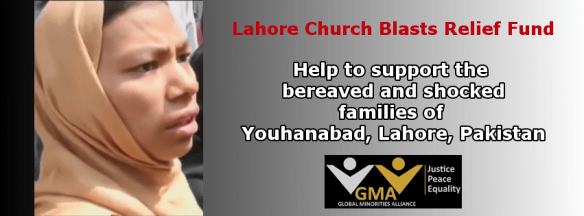
On Sunday March 15 2015, the peaceful worship of the largest Christian community in Punjab was disrupted by atrocious terrorist attacks. The Christian community of Youhanabad, Lahore​ had been the target of two suicide bombings in two churches which killed 15 people and left more than 70 injured.

GMA’s Chief Executive, Manassi Bernard commented: “Pakistan Government has failed on number of occassions to protect religious places inspite of consistent requests from local churches which, has contributed to these fresh violence and the irreplaceable loss of innocent lives.”

Mr Bernard further maintained that: “We can not imagine the trauma of families who lost their loved ones during the recent attack and we extend our condolence to the bereaved families.”
He further said: “It is the fundamental right of every citizen to protest when rights are suppressed but he further urged Christian community in Pakistan to protest without taking law in its own hand.”

We Are All One: solidarity across movements, from Selma to Karachi

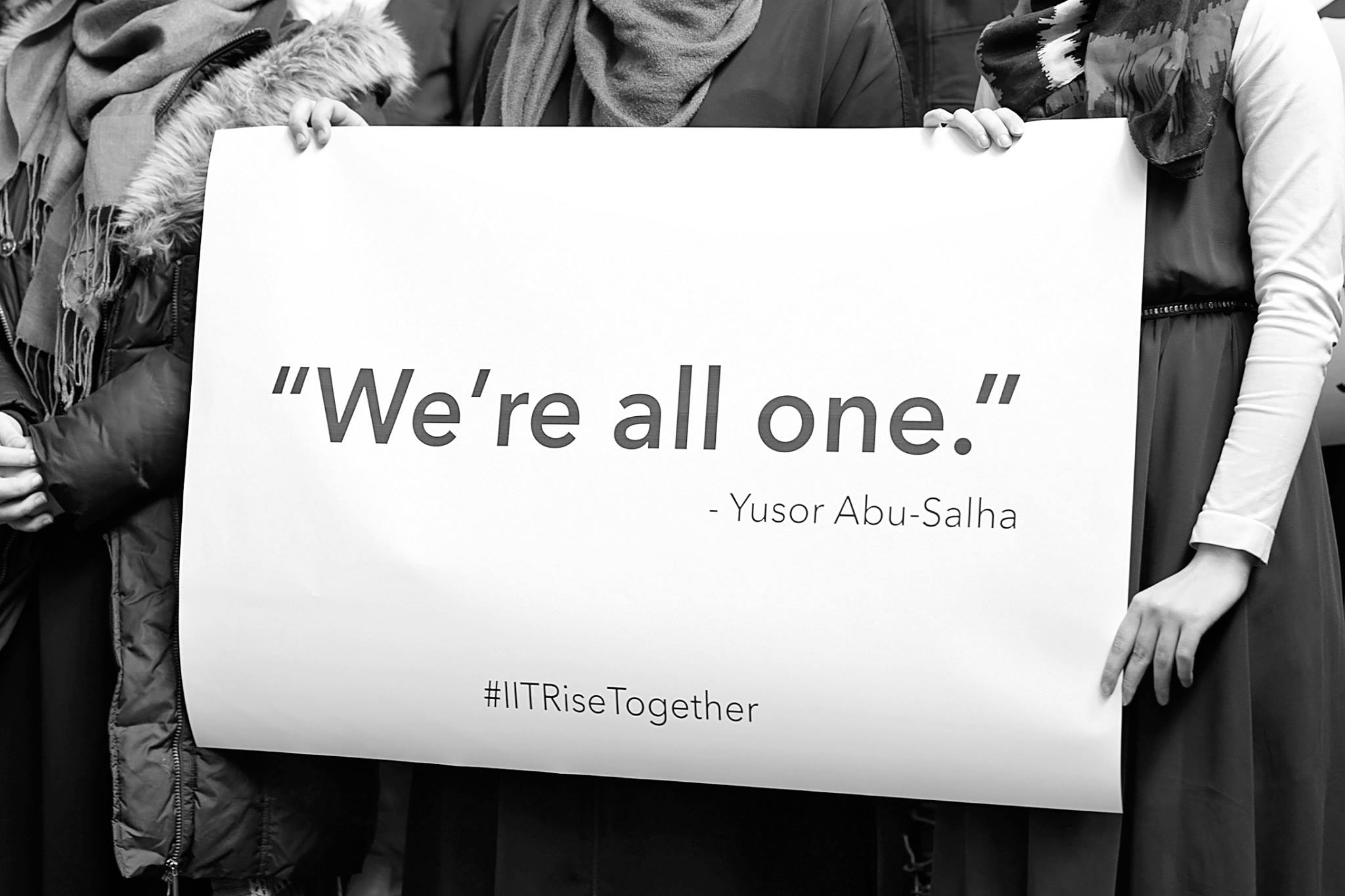
10985551_10203929904304852_2782570775884977801_o

By Lynne Marie Meyer

#BlackLivesMatter #MuslimLivesMatter #Selma #Montgomery #Karachi #WeAreAllOne #solidarityacrossmovements #GMABlog

“For many of us the march from Selma to Montgomery was about protest and prayer. Legs are not lips and walking is not kneeling. And yet our legs uttered songs. Even without words, our march was worship. I felt my legs were praying.” – Rabbi Abraham Joshua Heschel, after returning home from Selma.

March 21 2015 marks the 50th anniversary of a pivotal event in the United States. On that day, Reverend Martin Luther King, Jr., joined by thousands of others, began an historic march from Selma, Alabama to Montgomery, the state capitol.

One of the most important moments in the Civil Rights Movement, the march from Selma to Montgomery is also one of the great historic examples of interfaith solidarity. Clergy representing many faiths took part in this landmark event in support of African-American voting rights. Of these clergy, perhaps the most famous is Rabbi Abraham Joshua Heschel, widely considered to be one of the most important American religious figures of the 20th century.

According to his daughter Susannah, for Rabbi Heschel “the march was not simply a political demonstration, but a religious occasion.” It reminded him, she said, “of the message of the prophets, whose primary concern was social injustice, and of his Hasidic forebears, for whom compassion for the suffering of other people defined a religious person.”

I was reminded of this story some weeks ago, as my students prepared for Black History Month. Two groups that had previously never co-sponsored an event decided to do a lunchtime program looking at parallels between Ferguson and Gaza. It was an interesting idea, and students were eager to learn from one another. The morning of the event, I was already deep in thought, anticipating the program to come and reflecting on Rabbi Heschel and Rev. Martin Luther King, Jr., when suddenly I heard the news. Three bright, talented, and philanthropic young Muslim college students in Chapel Hill, North Carolina had been murdered in an apparent hate crime.

Continue reading →