How does one go about making Pakistan a secular state? It does not require a revolution as much it does an evolution. The fundamental rights of citizens must be safeguarded at all costs
Last month, the justices of the Supreme Court (SC) of Pakistan had a very interesting debate on whether Pakistan could become a secular state and what would be the modalities of turning it into one. This discussion should be welcomed by every Pakistani who wishes to see Pakistan a modern and successful state.
Who would a secular Pakistan benefit the most? The minorities? Minorities no doubt will be better off in a state that does not distinguish on the basis of faith but they would not be the only beneficiaries. Nor is the fact that Jinnah wanted a secular Pakistan the only reason why Pakistan should be secular. The real beneficiaries of the secular state in Pakistan would be the Muslims, for whose economic and political benefit the country was created in the first place. The misuse of Islam as an instrument of state policy has only served to divide Muslims along doctrinal and sectarian lines. As Pakistan moved further along the perilous course of cynical Islamisation under Zulfikar Ali Bhutto and then General Ziaul Haq, the biggest casualty has been the Muslim community itself, which now sees itself not as Muslim but as Shia or Sunni, Barelvi or Deobandi and so on and so forth. It has also encouraged fissiparous tendencies along ethnic and linguistic lines because Islamisation was seen as the buzzword for centraliaation. Paradoxically, it was the demise of Pan-Pakistan Muslim unity in 1971 that led to greater emphasis on religion in the country. The kind of Islamisation the country saw in the 1970s and the 1980s would have been impossible before the separation of Bangladesh.
The honourable justices of the SC spent some time ruminating over whether such a change would require a new constituent assembly or even a revolution. However, the broader question of what constitutes a secular state was ignored. Legal scholars define a secular state as one without a state religion. This definition is, however, quite limited with a number of exceptions. Some of the finest examples of secular democracy in the world today are the constitutional monarchies of Europe. These constitutional monarchies are in form confessional states with established churches. The examples of Sweden, Norway, Denmark, Netherlands and the UK may be quoted in this regard. Each of these states has an established national church. Instead of a strict legal separation of religion from state, these states have a fusion of church and state at the very top. The UK, for example, limits the monarchy through the Act of Settlement, 1701, to Protestants only. Yet, in practice, these states recognise that the religion of an individual citizen is the personal faith of that individual and their policy towards religion is determined by this principle. Closer to home, Bangladesh is a state that both commits itself to secularism as well as having a state religion through its constitution. Pakistan, which became an Islamic Republic in 1956, did not have a state religion until 1973. A K Brohi’s classic Fundamental Law of Pakistan gives a very practical reason for this deliberate omission: individuals have religion, states as artificial political constructs do not.
Pakistan may have adopted the state religion in 1973 but even the 1973 Constitution has been unable to fully purge itself of the small case of secularism. This Constitution in theory provides for the equality of citizenship for every Pakistani regardless of their faith and also provides for freedom of religion. The fundamental rights chapter of the Constitution, which are constitutionally placed above all else in even that basic document, is the embodiment of the secular principle. The path to a secular state in Pakistan has to be paved using these fundamental rights as tools of progress. Nor should the argument that Islam and secularism are polar opposites go unchallenged. The basic principle stated in the Quran — that there is no compulsion in religion — underscores the idea of the individual and his or her own spiritual self in the approach to God. It is this idea of spiritual individualism that does not negate but reaffirms the idea that no institution, not even the state, should come between the individual and his or her God. This is secularism in a nutshell.
So how does one go about making Pakistan a secular state? It does not require a revolution as much it does an evolution. The fundamental rights of citizens must be safeguarded at all costs. The state should ensure that no one is discriminated against because of his/her belief or the absence of it. Merit should be the only criteria in Pakistan for progress. This means that paperwork, including the ACRs of civil servants, should lose questions about religion added in by General Zia’s regime. The religion column on passports should also be removed. Religion should only be a secondary consideration in census and statistics. The state must also relieve itself of the burden of determining who is a Muslim and who is not. Ultimately, the office of the prime minister, at least, should be thrown open to all members of the National Assembly regardless of religious affiliation.
The 1973 Constitution can be changed into a pragmatically secular constitution without the convening of a constituent assembly. The makers of the 1973 Constitution specifically placed Article 239 in the Constitution to ensure that Pakistanis were not bound to their ideas for all times to come. The basic structure doctrine — whatever its objective — amounts to censure on the people of Pakistan. People and states evolve and do not remain hidebound. In my capacity, as a citizen of Pakistan, I appeal to the honourable justices of the SC to dispense with the basic structure doctrine altogether.
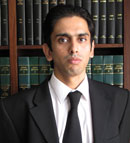 The writer is a lawyer based in Lahore, Pakistan and the author of the book Mr Jinnah: Myth and Reality. He can be contacted via twitter @therealylh and through his email address yasser.hamdani@gmail.com
This article first published in Daily Times and used here with the author’s permission