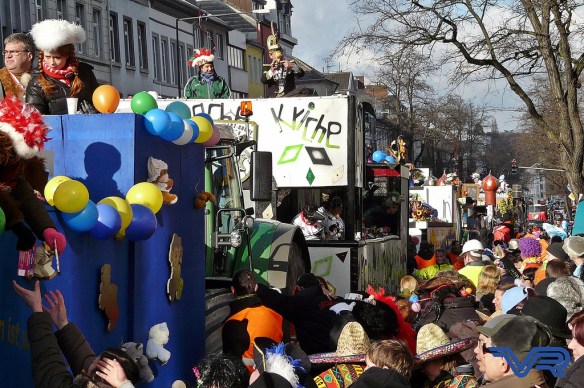
 Germany is preparing for Carnival Festivities/Neuwiser, Flickr
by Claire de Galembert, ENS Cachan – Paris-Saclay
Willkommenskultur, or “culture of acceptance”, has been a major part of the German political discourse since summer 2015. It evokes a spirit of solidarity towards the large number of migrants who have sought asylum in the European Union over the past year.
This commitment, together with the work of many volunteers to supplement state support for new arrivals, seemed to finally lift the shadows of Germany’s past – and almost made the world forget that it had long refused to consider itself a country of migration. The generosity seemed all the more spectacular with many of its neighbours being less than welcoming to new arrivals.
But the Germany of 2016 has a Willkommenskultur hangover. The country is in shock after the events of New Year’s Eve in Cologne, a city that has long been a symbol of German multiculturalism. And now, as Cologne prepares for its annual carnival festivities, the city has doubled its police presence and increased video surveillance. A local girls’ school will close on the opening day of the carnival to protect its students.
This is unsurprising when we recall the events of New Year’s Eve in Cologne, at least those that seem proven: women who came to the centre to watch the festivities were attacked by groups of men under the influence of alcohol, some of the men were described as of “Arab or North African origin” and some of them were asylum seekers.
The extent of the crimes was either little noticed or little admitted by the police, who initially described the evening as relatively peaceful. This optimistic assessment was quickly refuted by the exponential increase in complaints. By January 18, the total number of alleged crimes stood at 766, nearly half of which were sexual in nature, including three rapes. The head of police was suspended over his handling of the attacks.
‘We can do it’?
Willkommenskutur portrayed citizens as being ready to roll up their sleeves and take on the social and economic costs of integration of newcomers – estimated to be €50 billion by 2017. But it was far from universally felt in Germany. The continuous flow of arrivals, the difficulty of housing and integrating more than a million refugees, and disagreements within the EU over sharing the burden stoked scepticism within society at large, and among mainstream political parties. Meanwhile, the Islamophobic movement Pegida launched attacks on immigrants, both on social media (including the #raperefugee Twitter hashtag) and in the streets.
At a December meeting of the ruling CDU party, Angela Merkel received a long standing ovation after her speech on the refugees crisis, reaffirming her leadership within the party. But this has not stemmed the tide of complaints. Her mantra “Schaffen wir das!” (“We can do it!”) seemed to many to be more of an incantation than an expression of collective will.
The Cologne attacks have weakened the moral consensus that had formed around the Chancellor. And they were a godsend to Merkel’s critics, including the right-wing Alternative für Deutschland party. The events of New Year’s Eve fit perfectly with their preferred themes, particularly the link they draw between refugees and security, not to mention the difficulty of assimilating immigrants and the threat to Germany’s gender-equality standards.
Populist rhetoric
Beyond the rise of xenophobic violence, evidence of a shift in German attitudes is widespread. A regional mayor in Bavaria sent a group of immigrants by bus to Berlin to protest Germany’s asylum laws. In an interview, none other than former chancellor Gerhard Schröder asserted that Europe’s doors couldn’t be left open forever:
The capacity to take in, care for and integrate refugees in Germany is limited, not unlimited. Anything else is an illusion.
The unease has been felt even more strongly in other European countries. Germany’s willingness to meet the challenge of mass immigration through its Willkommenskultur has been unbearable for its neighbours. Many seized on the situation as evidence that they were right all along about the need to close Europe’s borders – and to call into question Merkel’s unilateral choice to open them. The prime minister of Slovakia, Robert Fico, went so far as to say that “migrants cannot be integrated”.
Germany’s populist movements have their parallels elsewhere, from the National Front in France to Nigel Farage and UKIP in the UK and Republicans Donald Trump and Ted Cruz in the United States. After the attacks, Trump went to Twitter in an attempt to link immigration and insecurity:
Germany is going through massive attacks to its people by the migrants allowed to enter the country. New Years Eve was a disaster. THINK!
— Donald J. Trump (@realDonaldTrump) January 6, 2016
Ethical responsibility
But beyond the populists and xenophobes, signs are everywhere of a more difficult political climate. Not just the closing of borders, but also a hardening of tone – for example, a proposed law in Denmark would authorise the confiscation of refugees’ valuables. It’s a safe bet that the spreading appeal of anti-immigrant attitudes, once limited to the extreme right, will harm immigrants already living in Europe, especially Muslims.
The erosion of Willkommenskultur means Germany must leave behind the moral stance underpinning Angela Merkel’s position and return to the ethic of responsibility, as laid out in the work of German sociologist and philosopher Max Weber. This requires consideration not only of the economic capacity for absorbing such an immense wave of immigrants but also its social and political acceptability. Failing to do so risks aggravating the panic emerging in Germany and beyond.
But the ethic of responsibility doesn’t obviate the need to come up with a balanced European response to immigration that remains true to the rule of law – otherwise, the populist rhetoric will continue to have a wide appeal. Between the pitfalls of being insufficiently attentive to the concerns of a growing percentage of the German population and giving in to the diktats of the extreme right, the way forward is a narrow one, but it exists.

Claire de Galembert, Sociologue CNRS, ENS Cachan – Paris-Saclay
This article was originally published on The Conversation. Read the original article.