Global Minorities Alliance calls for inclusion and Roma rights

Press Release

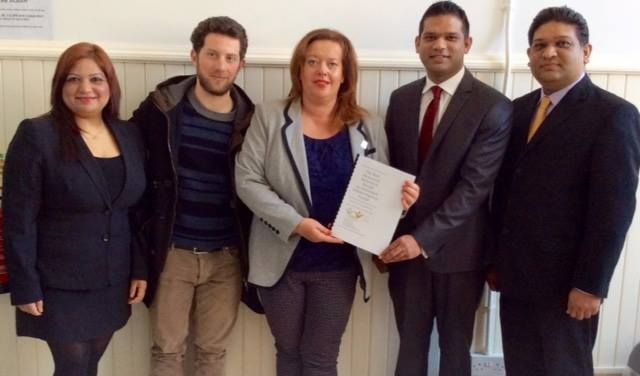
GMA delegates with Anne McTaggart, Member of Scottish Parliament

GMA delegates with Anne McTaggart, Member of Scottish Parliament

Global Minorities Alliance is highlighting the plight of the most persecuted minority in Europe, and urges the Scottish Government to introduce national laws to aim for the inclusion and protection of Roma communities in Scotland.

The Alliance also calls for a commission to be set up to counter anti-gypsyism to address the current negative stereotyping of Roma in Scotland.

To commemorate 8th April, which is International Roma Day, the Alliance has also published a report which examines four core issues faced by Romacommunities across Europe, i.e political discrimination, lack of political representation, statelessness and urban marginalisation.

The report highlights the decades-long marginalisation of one of the most vulnerable ethnic groups in the continent; a group which continues to face obstacles on their way to having their full human rights, as well as socio-economic entitlements, recognised.

Since their migration to Europe in the 12th century, Roma people have faced enslavement, abuse and discrimination. The persecution reached a climax during World War II ,where Roma people were systematically slaughtered by the Nazis. The Alliance report recommends that European states should establish Truth and Reconciliation Commissions to fully recognise the mass atrocities faced by Roma during War World II. The recognition of this ‘forgotten genocide’ might be a way to restore trust between Roma people and European society. Continue reading →
Paris attacks should not eclipse the horrors of Boko Haram in Nigeria

Press release

For immediate use

Global Minorities Alliance, a Glasgow based human rights organisation, has called on world leaders not to ignore the horrors of Boko Haram amid reports that around 2000 people were killed in Nigeria in the most recent spate of violence.

The carnage is reported to have occurred in the Nigerian town of Baga, on the border with Chad, where the militant group seized a military base on 3 January. The clashes between security forces and militants continued throughout the first week of January.

Eyewitnesses recall scenes of violence during the attack which has been branded Boko Haram’s ‘deadliest massacre’. The victims include children, women and elderly people who could not run fast enough when insurgents attacked the town spraying grenades and bullets.

The human carnage perpetrated by Boko Haram in Baga was enormous. Mr Abba Gava, a spokesperson of an armed civilian group that fights Boko Haram, told Associated Press: “No one could attend to the corpses or the seriously injured ones who also may have died by now.”

The Alliance’s Chief Executive, Manassi Bernard, lambasted the West’s half-hearted attempts to intervene and assist the military forces and local defence groups who are ill-equipped to counter any assault by Boko Haram, who have modern and hi-tech weaponry.

“The Paris attacks should not eclipse the horrors done by Boko Haram who attack and kill innocent people at whim,” he further stressed.

“As we have witnessed world leaders in the million march in Paris, we urge them to unite to combat terrorism in Africa as well.”

The Alliance’s Director of Diplomatic Affairs, Rebecca Gebauer, condemned the abuse of girls and women to further the terror agenda of militants and fundamentalists around the world. As an example she mentioned the recent suicide bomb attack in a Nigerian market in Borno state. A 10-year-old girl was strapped with bombs and detonated in the middle of the market, which killed 19 people.

“Girls are often easy targets for these fundamentalists who use them for their nefarious propaganda,” Ms Gebauer said. She also called for people to remember the more than 276 school girls who were kidnapped by Boko Haram in April 2014.

Following an international outcry and the popular social media campaign #BringBackOurGirls, which generated more than 4 million tweets and among others was supported by the US First Lady Michelle Obama, today the girls are a forgotten story.

The majority of the girls have not returned since and are thought to have been married off, leaving behind traumatised parents and families.

“It is disappointing to realise that the cost of human life varies in different parts of world,” Ms Gebauer said. “Had this tragedy occurred in the West, every effort would have been put into to make sure girls are safe and with their families.”

Around 10,000 people have been killed alone in last year as the result of the Boko Haram quest to carve out an Islamic caliphate in a religiously diverse Nigeria.


2015: a new hope for peace

GMA

By GMA

So 2014 is coming to an end. What have we learnt this year?

We’ve learnt a number of words – ISIS, Yazidis, Boko Haram, #bringbackourgirls (and most recently #sydneysiege #PeshawarAttack) that fill us with sadness and fear.

We’ve learnt that the world is not always the place of safety that we would like it to be for everyone and anyone, regardless of race, religion, nationality, ethnicity, sexuality, gender or background.

We’ve learnt that there seems to be an unlimited amount of war that can be fought in the name of hatred, an unlimited depth for people to sink to (the last two weeks have proved this to us through the Peshawar school attack), and a seemingly unlimited amount of persecution in the world.

And yet with 2015 comes a new dawn; a new year and a new start, with new things to learn. Because although the world in 2014 has seemed so cruel, the goodness of people still shines through.

For example, to combat Islamophobia in the wake of the Sydney cafe siege, the hashtag #IllRideWithYou showed solidarity with Australian Muslims in the hope that they would feel safe and not fear retribution for the actions of one man.

To show the Taliban that they cannot halt the march of female empowerment, Malala Yousafzai continued calling for worldwide access to education, culminating in her co-winning the Nobel Peace Prize this year.

And, finally, in GMA’s native Scotland, equal marriage became legal on 16 December 2014, meaning a gay person now has the same right to marry the one they love as a heterosexual person does. In a world where gay communities are sometimes punished by death, this is a massive step along the path towards global equality.

As these small victories show, there is always goodness to counterbalance the depths of despair. And with this, there is always hope that 2015 will be a more peaceful, a more equal, and a more just year, leading to a better world for us all.

And, to help make sure that happens, Global Minorities Alliance will be there every step of the way to help make sure minority communities have a voice and persecution is challenged, wherever it presents.

Have a Merry Christmas and a Happy New Year.