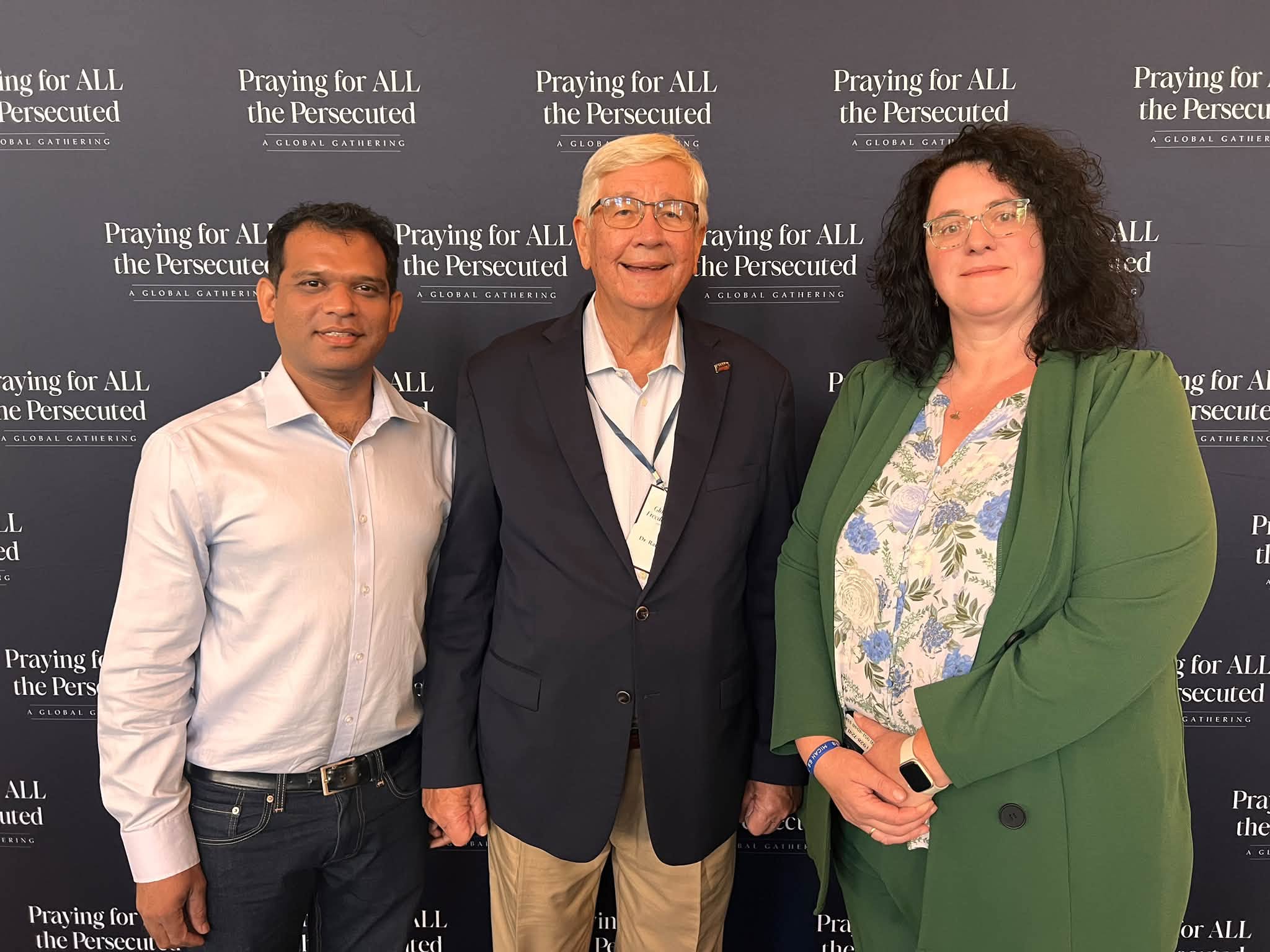
by Shahid Khan & Rebecca Gebauer
It is always a curious privilege to enter a space where people agree on an issue that remains deeply contested elsewhere. At the Global Religious Freedom Gathering at Dallas Baptist University (DBU) that agreement was simple: religious freedom for one religion must mean religious freedom for all.
At first, bringing together practitioners already engaged in fighting persecution across faith and religious boundaries might seem like gathering people who already agree to tell one another what they already know. Yet there is value in sharing testimonies of persecution even among people who have themselves lived through persecution. The question, then, is what such encounters can add beyond confirming a reality already deeply understood.
The opening dinner already offered one answer. Students from DBU and Baylor joined practitioners and advocates with Pastor Ezra Jin, who shared his experience of surveillance and eventual imprisonment in China. Listening to his testimony was humbling. His passion came through clearly, even though he spoke in Chinese, with his daughter Grace translating for him. He showed what the absence of religious freedom looks like in real life.
The following day shifted from testimony towards what practitioners do with that knowledge. At the start of the panel day, Rev. Dr. Randel Everett offered a wonderful image: “Lighthouses do not compete with each other.” They stand in different places, shine into different stretches of darkness and warn of different dangers. But their purpose is shared.
For us personally, given our Christian backgrounds, a panel of Baptist pastors provided one of the more thought-provoking moments of the day. The pastors reflected that persecuted Christians may encounter parts of the Bible rather differently from those of us who have always been free to read it: much of the New Testament was itself written by persecuted Christians to persecuted communities. They also made a deceptively simple point. The Bible stands on its own merit; it does not need legal protection to make its message true. Christians need freedom to share their faith, not legal privilege for that faith.
That distinction reaches far beyond Christianity. If we claim the freedom to profess, practice, and share our own beliefs, we must defend that same freedom for people of other faiths, for those who change their faith, and for those who profess no faith at all. Religious freedom ceases to be meaningful if it protects only those with whom we agree.
Simple? Perhaps. Easy? Certainly not.
That became particularly apparent during the practitioner discussion moderated by Scot Bower of Christian Solidarity Worldwide. We live, he suggested, in a world increasingly described by the acronym BANI: brittle, anxious, non-linear and incomprehensible. Modern conflicts, polarized societies and weakened multilateral institutions have changed the environment in which religious freedom advocacy takes place. The discussion repeatedly returned to the fact that traditional justice advocacy increasingly overlaps with peacebuilding.
This poses difficult questions. How do you advocate for a persecuted community when conflict has hardened identities? How do you defend religious freedom without simply adding another dividing line? And what happens when the international institutions through which advocacy once worked become less effective?
The later panels widened the lens further, looking at the relationship between religious nationalism and democratic governance and at how advocacy can move beyond international institutions by strengthening partnerships closer to the communities concerned. Together, they reinforced how many different levels—from local relationships to national politics and international institutions—shape whether freedom of religion or belief can actually be realized.
The closing session brought those different strands back to the people at their center, with prayers offered for Ukraine, China, Pakistan and Sudan. It was particularly heartening to see Mohanad El Nour contributing to the gathering. As a Muslim Sudanese human-rights lawyer working with Christian Solidarity Worldwide, El Nour has advocated for persecuted Christians in Sudan. There was something quietly powerful in that. The principle discussed throughout the gathering was being lived out in the room: defending another person’s freedom of belief does not require sharing that belief.
Perhaps this is precisely why gathering people who already share that commitment matters. In a world that is brittle, anxious and increasingly divided, practitioners need opportunities to exchange experience, encourage one another and remember that protecting one community cannot come at the expense of another.
We left heartened by practitioners facing circumstances more challenging than many of us can imagine and yet remaining hopeful and committed. We also left with a stronger appreciation of what such gatherings make possible.
Perhaps a gathering like this is not simply reinforcing shared convictions. Perhaps it is reminding the lighthouses that they are not standing alone.